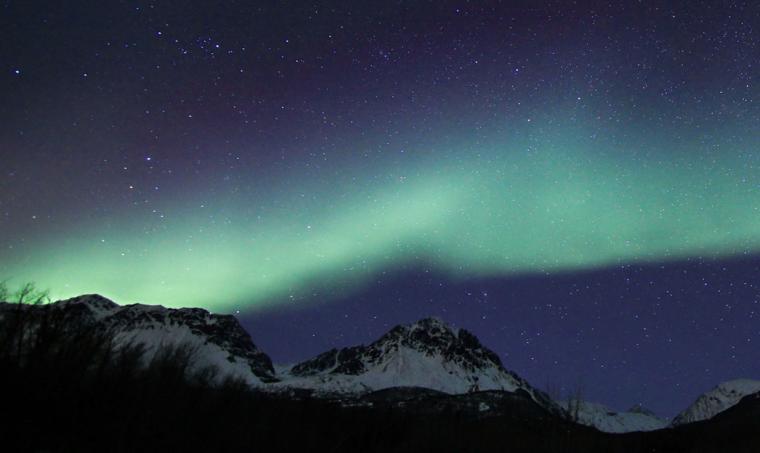
Seeing the Northern Lights in person is (hands down) one of the most striking experiences Alaska has to offer. While there are several vantage points across the state, The Mat-Su Alaska provides a quieter and less crowded place to watch the aurora move across the sky. It’s an excellent base for travelers looking to experience the aurora with plenty of nearby lodging and outdoor activities to sweeten the deal.
The Mat-Su: Your Gateway to the Aurora
The Mat-Su’s latitude places it firmly within the “auroral zone,” typically between 60° and 70° North. This means The Mat-Su is far enough north to experience the aurora consistently. Plus, The Mat-Su’s proximity to Anchorage offers quick and easy access.
The Mat-Su has several well-known vantage points for aurora chasing:
- Hatcher Pass: Hatcher Pass’s higher elevation helps mitigate ground fog and offers a broader, unobstructed view of the northern sky.
- Talkeetna: This charming community provides stunning views that create truly incredible photographic compositions with the aurora dancing overhead.
- Willow and Big Lake: These communities offer more open areas with less light pollution, making them ideal for clear, dark sky viewing.
If you’d rather enlist the help of an Alaska aurora tour guide, several options are available for groups. Excursions include visits to heated cabins, yurts, lodges, and even overnight sled dog expeditions.
When to Witness the Aurora?
A successful aurora borealis tour hinges on timing. The prime window of September to April offers the longest and darkest nights to see the lights.
Optimal hours for viewing the aurora are typically between 9:00 p.m. and 5:00 a.m., with 2:00 a.m. often being the most active time. This means you need to be prepared to stay up late, dress warmly, and exercise a little patience.
Photography Tips for Capturing the Aurora Borealis
While smartphones can capture decent photos, bringing along a proper camera with manual settings will significantly enhance details in low-light conditions.
Essential Gear:
- Camera Body: DSLR or mirrorless camera with manual controls.
- Lens: Wide-angle (14mm-35mm) with a large aperture (f/2.8 or lower) for capturing vastness and maximizing light.
- Sturdy Tripod: Essential for long exposures to prevent blurry photos.
- Remote Shutter Release: Prevents camera shake.
- Other Essentials: Extra batteries (cold drains them quickly!), a headlamp with red lights (preserves night vision).
Recommended Settings:
- Camera Mode: Manual (M).
- Aperture: Lowest possible f-number (e.g., f/2.8 or f/4).
- ISO: Start at 1600; adjust based on brightness and camera performance.
- Shutter Speed: Begin at 20 seconds; shorten for active aurora, lengthen for dimmer displays.
- Focus: Manual focus to infinity.
The aurora's intensity changes rapidly, so make sure you adjust settings regularly. If your images are overexposed, lower your ISO and/or shutter speed. Happy experimenting!
Stay Warm and Stay Safe
Experiencing the aurora means spending several hours outdoors during winter. The Mat-Su’s winter night temperatures can range from around freezing, 32°F, to well below 0°F. The golden rule is layering: multiple, thinner layers trap warm air more effectively than a single bulky garment. Avoid cotton, as it loses insulation when wet, and make sure to pack a hat, gloves, a neck gaiter or buff, or a balaclava. The advantage of booking an aurora tour is that most guides can provide much of the gear to keep you warm and comfortable out there.
If you’re looking for more tips on how to get out there in the wild in the Mat-Su, check out our list of things to do. Alternatively, get more information to plan your Alaska aurora borealis tour here!